Tracing the Huguenot Cross: How a Search for Family Identity Revealed a Proud Protestant Legacy

Why did my mother wear a Huguenot cross? How did a Belgian soldier in the garrison town of Kampen change our family name? Through genealogical research, I discovered our direct descent from John Calvin’s followers. From strict Protestant roots to the Dutch Reformed Church, this is a journey of faith, history, and identity
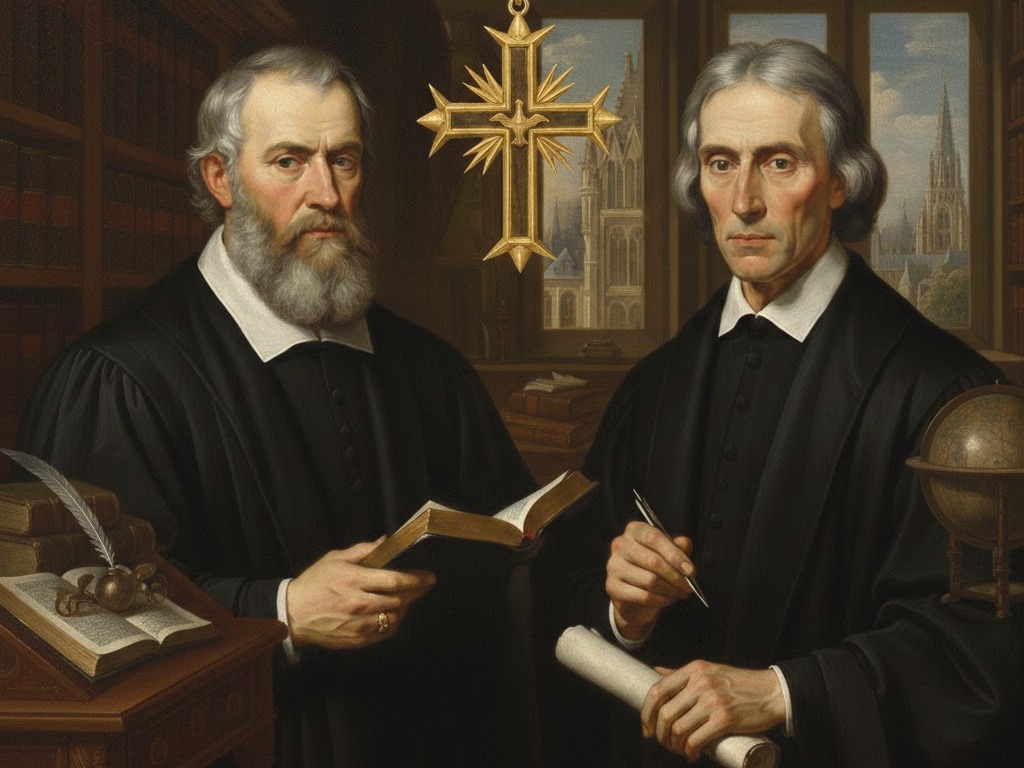
Picture: Luther and Calvijn (Google)
Historical Curiosities and Unexpected Life Discoveries
As you will know by now, I love to dive into history every now and then. And I can say that this gives me some nice surprises every now and then. Things or facts that I was not necessarily looking for beforehand then unexpectedly cross my path in life. A while ago I dived into the world religions, you have already been able to read this in my stories about Indian swamis and the how and why of Saint Nicholas.
Unanswered Questions: A Childhood Search for Closure
Now at the age of sixty-four, I was looking around on all kinds of internet forums again, because three things were still going through my head from my earliest childhood that I couldn't let go of after all these years. You should know that my mother died when I was nineteen years old, and my father when I was twenty-nine. As a result, I have not had a chance to ask them these questions personally.
The Three Mysteries: Faith, Behavior, and the Huguenot Cross
The first question was: "Once in my then young life I heard that there was a story going around that my parents had changed churches (faith), but why?" The second question was that I had not always understood the behavior of my mother, who died far too early, in some situations. My parents never went to church, but they did have two paintings hanging above their bed with the texts: "Solid rock of my salvation", and "The Lord is My Shepherd." In addition, I think that despite quite severe setbacks in her, and our lives, my mother always walked straight with confidence. And finally the third question: "Why did my mother wear a "Huguenot cross?"
Digital Exploration: Turning to Genealogical Research and Family Search
So I have been walking around with all these questions for about thirty years. As I mentioned earlier, I kept looking around on the internet, to see if I would find the answers to my questions by chance. One day I read an article about genealogical research, it touched me. I decided to investigate on the platform "Family Search" how far I could get with this. Now you should know that this forum also collects data for you (AI?). Soon I ran into the fact that I did not get any further in my search than about 1700 AD.
The Garrison City: Kampen During the Napoleonic Era
What I quickly noticed at that time is that there was a name change in my father's family history that I could not quickly place. There was a single mother with a daughter in my family who got into a relationship with a "Belgian" soldier from Brussels around 1700. This in itself was not so strange because the daughter lived with her parents (my ancestors) in the Dutch city of Kampen. Upon further research, I discovered that the city of Kampen was a garrison town at the time of the European struggle under the French Emperor Napoleon Bonaparte. This was also the time when every citizen had to record a fixed surname on his orders.
The Mystery of the Double Surname: Bakker and Albert
The daughter Hannah Bakker and the Soldier also had a son together despite not marrying. The name of this son was in full David Guilliame Bakker – Albert, the daughter had the name Grada Frederika Bakker – Albert Both were adopted by the father Jean Louis Albert and officially registered with the municipality of Kampen as being his children. At first I paid little attention to this, because the parental couple was not married, I thought: "that must have been normal in 1700. This lasted for a while until I suddenly discovered that I had had an uncle from around 1900 who had the same nicknames as the aforementioned son of the French soldier, he, my uncle only had the name Bakker (my last name) as a surname, so why the double surname?
Opening Doors: Uncovering the Soldier Jean Louis Albert
I searched further on both surnames, and even corrupted the name Bakker to Backer or Backker, but found nothing interesting. Then I searched for the Belgian/French name "Albert." From that moment on, several doors opened for me that I could not have imagined in my wildest dreams. The name Albert was directly linked to the status of Belgian soldier, stationed around 1700 in Kampen. The daughter Hannah Bakker was the only child of her parents "Berend Bakker" and "Engelina Antonetta de Moor", and indeed an unmarried mother until she met the Belgian soldier Albert, The couple decided after the second child (Daniel) not to marry because father Jean louis Albert the father had to leave for the east (Indies) as a soldier immediately after the birth of the joint son.
The Huguenot Connection: Fleeing Religious Persecution in France
When I discovered that and searched a little further, I also understood the posture of my mother and her Huguenot cross. Jean Louis Albert was a Huguenot who fled from France around the year 1700 for the Spanish Catholics, so I knew immediately that I was, or am, a direct descendant of the Huguenots, the followers of John Calvin (10-07-1509-27-05-1764). I was also able to explain my mother's behavior almost immediately. She Johanna Bakker-Neervoort (15-12-1916 - 16-02-1981) had therefore been born and raised in a strict Protestant. Both my parents had been strict churchgoers and followers of Calvin until a fairly advanced age.
Adapting the Faith: The Shift to the Dutch Reformed Church
A small detail that makes the situation a little clearer was the fact that I discovered that somewhere in their lives they could no longer meet the standards of the Strict Protestant Church because of the obligations to our large family (9 children), and because of this they had switched to the Dutch Reformed Church, which was a little less strict in "the Doctrine". This explained the attitude of a proud Protestant mother.
A Proud Protestant Identity: The Legacy of Calvin and Luther
Can I now call myself a proud Huguenot? A follower of Calvin who, together with Martin Luther (10-11-1483 -18-02-1546), denounced the sense, the nonsense and the abuse of the Catholic Church? Without them, this "church", or this faith, would still be busy with the indulgence, (the bequeathing of possessions to that faith community after death) that led to a lot of poverty and other inconveniences for willless illiterates in and around 1500, because they could not know that this was not in the Christian Bible at all , or that it was God's will!