
Conflict and Consequence: The Transformation of Nations Through War

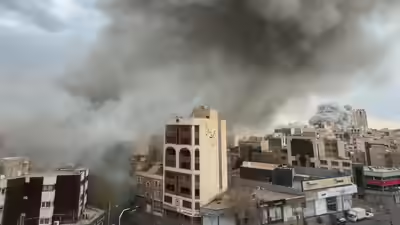
Abstract: War has been one of the most powerful forces shaping the trajectory of nations, leaving enduring imprints on political institutions, economic systems, and social structures. This article examines how armed conflict transforms nations during and in the aftermath of war, focusing on both immediate disruptions and long-term consequences. Drawing on interdisciplinary perspectives, the paper analyzes patterns of war consequences and the reconfiguration of national identities.
Introduction
War has long been a defining force in shaping nations, influencing their political structures, economies, and social identities [1-3]. While conflicts bring immediate destruction and instability, they also set in motion profound transformations that can ultimately redefine a country’s developmental trajectory. This article examines how war serves not only as a moment of crisis but also as a catalyst for lasting national change, exploring the complex relationship between conflict and its consequences. War accelerates political centralization, alters power dynamics, and often leads to the emergence of new institutional frameworks. Economically, conflicts can devastate infrastructure and production while simultaneously catalyzing innovation and industrial change. Socially, war reshapes demographics, deepens inequalities, and influences collective memory and cultural narratives. Grasping the nature of these changes is crucial for evaluating the enduring effects of conflict and developing effective strategies for sustainable peace and reconstruction. Considering emerging geopolitical challenges, modern conflict resolution demands a sophisticated approach that incorporates high-level diplomatic engagement and the involvement of credible mediators. The diverse paths of post-war recovery, highlight the pivotal roles played by international intervention, domestic policy decisions, and the resilience of societies.
Nations at War and Their Consequences
War between nations produces catastrophic and long-lasting consequences that extend far beyond the battlefield [4-7]. It leads to massive loss of life, widespread destruction of infrastructure, and profound psychological trauma, leaving millions emotionally devastated and struggling with mental instability. Economically, war triggers inflation, mounting debt, capital flight, and prolonged poverty, often suppressing GDP and development for decades. Socially, it creates large-scale displacement, refugee crises, and breakdowns in healthcare and education systems, resulting in ‘lost generations.’ Environmental damage further compounds the crisis through pollution, ecosystem destruction, and lingering hazards such as unexploded artillery. At the institutional level, weakened governance and law enforcement can fuel organized crime, illegal arms trade, and extremism, necessitating stronger drives against such threats alongside efforts to rebuild trade networks. Globally, conflicts disrupt trade routes, destabilize energy markets, and strain international relations, ultimately diverting resources away from sustainable development. These interconnected impacts persist long after wars end, obstructing recovery efforts and sustaining cycles of instability and generational trauma that can endure for decades.
Geopolitical conflicts often extend far beyond the battlefield, leaving deep and lasting imprints on societies. Over time, such conflicts reshape language, cultural practices, customs, and even cuisine, as populations adapt to external influences, displacement, and prolonged instability. These transformations become embedded in national identity, reflecting both resilience and historical trauma. Efforts to assert control over a nation or region frequently involve restricting access to critical transit points, such as international waterways, which can disrupt global trade and heighten tensions. In such scenarios, multiple countries may become entangled, either directly or indirectly, increasing the risk of wider conflict. Concerns over strategic resources further intensify competition, making de-escalation both urgent and complex. Modern warfare has shifted toward advanced, technology-driven methods. National leaders and key targets can now be threatened by long-range missiles and unmanned drones operated remotely. This evolution highlights the increasing significance of cyber capabilities, surveillance systems, and precision weaponry in determining military superiority. Conflicts rarely remain contained within borders. Spillover risks can destabilize neighboring regions, disrupt supply chains, and lead to shortages of critical energy resources. These challenges pose significant threats to national security and economic stability, particularly for countries dependent on external supplies.
Practical Solutions Toward Peace
A nation’s defence budget increasingly reflects the need for comprehensive modernization. Investments span advanced technologies, such as artificial intelligence, hypersonic missiles, aircraft carriers, destroyers, cyber warfare systems, quantum technologies, and space-based assets. Alongside these, adequate manpower, infrastructure, and maintenance are essential to ensure readiness for future conflicts across land, naval, and air domains. Building robust strategic capacity requires a balanced strengthening of land forces, naval power, and air defences. Nations must focus on integrated capabilities that foster coordinated responses to diverse threats. Preparedness also involves anticipating emerging forms of warfare and ensuring forces are equipped and trained accordingly. Developing critical defence technologies is essential for maintaining strategic autonomy. The effective use of advanced technologies, guided by a thoughtful and forward-looking defence policy, can be decisive in both deterrence and conflict management. Clear policy direction ensures that technological advancements translate into real-world capabilities [8-11].
Prioritizing domestic manufacturing in defence, through building factories, designing components, and establishing large-scale production and fabrication facilities, enhances self-reliance. This approach reduces dependence on external suppliers and strengthens national resilience, while fostering economic growth and technological expertise. Protecting citizens remains a central responsibility during times of conflict. Governments must address internal challenges such as separatist movements and the influence of vested overseas interests, which can exacerbate instability. Ensuring internal cohesion is as critical as external defence. Conflict often necessitates the redirection of capital and resources across sectors and regions within a nation. A balanced approach that supports both export-oriented growth and domestic consumption is vital. Addressing structural bottlenecks and inefficiencies can help sustain economic momentum even under challenging conditions. Ultimately, long-term stability depends on a commitment to peacebuilding and de-escalation. A strategic roadmap that emphasizes diplomacy, sustainable development, and inclusive growth can help nations transition from conflict toward resilience and prosperity.
Conclusions
A comprehensive solution to war must combine decisive action with long-term stability measures. A clear proposal to end the war should be initiated through diplomatic channels, setting firm conditions for a ceasefire while keeping pressure on all parties. In situations where negotiations fail, a massive ground attack and multiple waves of missiles may be used strategically to weaken hostile capabilities, though always calibrated to prevent direct and indirect losses among civilians and infrastructure. The threat of a nuclear response can act as a powerful deterrent, but it must remain a last resort due to its catastrophic consequences. Equally important is the need to hold aggressors accountable through robust international mechanisms, ensuring that perpetrators of peace violations face appropriate consequences. Integrating military strength with legal and diplomatic enforcement enables nations to establish credible deterrence, discouraging future conflicts while advancing sustainable and peaceful resolutions.
In conclusion, war remains a deeply destructive yet transformative force in the evolution of nations. While it inflicts significant human, economic, and social costs, it also reshapes institutions, identities, and developmental paths in lasting ways. An accurate understanding of how nations rebuild and adapt after war requires acknowledging not only the immediate devastation caused by conflict but also its enduring consequences. This comprehensive perspective is crucial for developing effective strategies that foster lasting peace and stability in post-war societies. A nation may increasingly be defined by how effectively it integrates human intelligence with artificial intelligence, particularly through brain-computer interfaces, to drive outcomes, achieve sustainable development, and realize a transformative vision. In the aftermath of war, national identities are often reconfigured as societies reinterpret shared histories, sacrifices, and losses to rebuild a sense of unity and purpose. This process can foster renewed cohesion and resilience but may also deepen divisions if collective memory and narratives remain contested.
References
- Stein, A. A., & Russett, B. M. (1980). Evaluating war: Outcomes and consequences. Handbook of political conflict: theory and research, 399-422.
- Dudziak, M. L. (2012). War time: An idea, its history, its consequences. OUP USA.
- Ender, M. G. (2010). War: Causes and Consequences.
- Knorr, K. E. (2015). War potential of nations. Princeton University Press.
- Iqbal, Z. (2010). War and the Health of Nations. Stanford University Press.
- Hinde, R. A. (1997). War: some psychological causes and consequences. Interdisciplinary Science Reviews, 22(3), 229-245.
- Brauer, J. (2009). War and nature: The environmental consequences of war in a globalized world. Bloomsbury Publishing USA.
- Doll, W. J., & Metz, S. (1993). The army and multinational peace operations: Problems and solutions. Strategic Studies Institute, US Army War College.
- Stoessinger, J. G. (2010). Why nations go to war, St Martin's Press, 188-90.
- Silberner, E. (2015). The Problem of War. Princeton University Press.
- Geller, D. S., & Singer, J. D. (1998). Nations at war: A scientific study of international conflict, Vol. 58, Cambridge University Press.

Polyvinyl Alcohol, Microplastics, and Misleading Sustainability Claims: An Analysis of Global Environmental Policy Gaps

World War 3 Predictions: NATO, Europe, Russia, Nostradamus, Bible Prophecies, and Global Conflict in 2025

Van Lier Shoes Bankruptcy: Historic Dutch Leather Shoe Brand Faces Closure, Debts, and Uncertain Future Plans