The History of Durga Puja in Bengal

Introduction:
Every autumn, Bengal comes alive for five days in the name of Goddess Durga. But have we
ever stopped to wonder how this celebration became such an inseparable part of Bengal's
identity?
The Durga we worship today is not represented in exactly the same way everywhere. The
rituals differ, the idols differ, and even the way the goddess is imagined has been shaped by
different religious traditions and centuries of social and cultural change.
So where does the story of Durga Puja in Bengal actually begin? In mythology, ancient texts,
the courts of kings and zamindars, or in the neighbourhoods where the festival eventually
became everyone's celebration?
Origin of Durga Puja in Bengal – Mythology
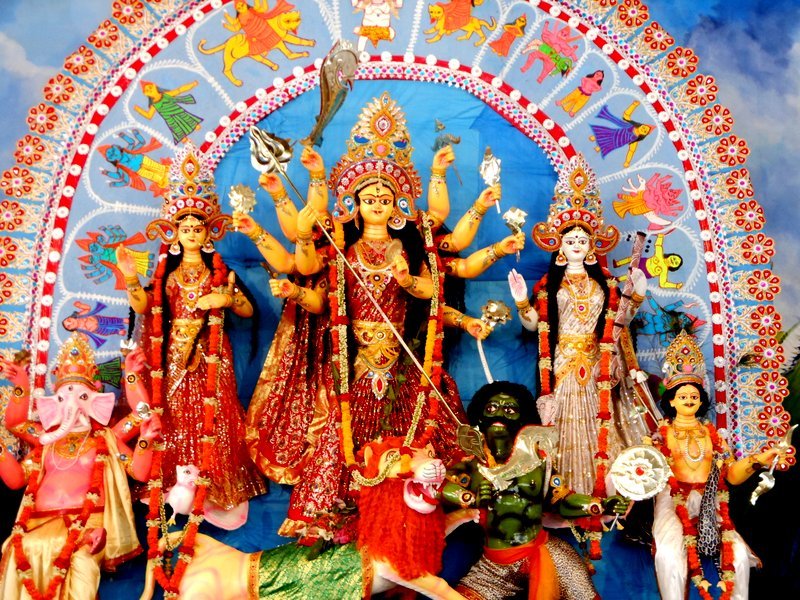
Bengali tradition brings together two images of Goddess Durga: Devi Mahamaya, the
warrior who defeats Mahishasura, and Uma, the married daughter who returns to her
maternal home every autumn.
The Ramayana tells of Lord Rama invoking Durga in autumn before his battle with Ravana,
giving rise to the tradition of Akal Bodhon.
Bengali folklore then transforms the goddess into Uma, daughter of Himalaya and Menaka,
returning from Kailash with her four children for a brief visit. On Dashami, she leaves for
Kailash again, symbolised by the immersion of her idol.
Basanti Puja – The Original Season
Durga Puja is traditionally associated with spring, and this form of worship is known as
Basanti Puja. The goddess, idol and rituals are essentially the same as those of the autumn
Puja, with the offering of 108 lotuses being one of the notable differences.
The autumn Puja is traditionally linked to Lord Rama's Akal Bodhon—his invocation of
Durga at an unusual time before his battle with Ravana. Over time, this autumn worship
became far more popular in Bengal, while Basanti Puja continued as a smaller tradition.
So, the Durga Puja that Bengal celebrates with such grandeur today is, in a sense, an
“untimely” Puja that eventually became the main one.
Durga Puja in Bengal – History
Though goddess worship is mentioned in ancient texts such as the Mahabharata and the
Puranas, autumnal Sharadiya Durga Puja took shape in Bengal much later. By the late 1500s and early 1600s, wealthy zamindars in places such as Malda, Dinajpur, Taherpur and Nadiawere organising grand autumn Pujas. The Sabarna Roy Choudhury family began its Barisha
Puja in 1610. Historical accounts also associate early grand Pujas with figures such as Raja
Krishnanarayan of Taherpur and Bhabananda Mazumdar of Nadia.
In Guptipara, Hooghly, a group of friends is traditionally credited with organising a Puja
through public contributions after being excluded from a landlord's private celebration,
giving rise to the Baroyari tradition. The exact date is disputed, with different accounts
placing it in the 1760s or around 1790.
By the early twentieth century, community Pujas began transforming Durga Puja from a
predominantly household celebration into a public festival. The Bhowanipore Sanatan
Dharmatsahini Sabha's 1910 Puja is widely cited as an important early registered communityPuja in Kolkata.
Shobhabazar Rajbari Puja
The Shobhabazar Rajbari Puja has a rather unusual history. Raja Nabakrishna Deb began the
Puja at Shobhabazar in 1757, soon after the Battle of Plassey. The popular story says that,
after the British victory over Siraj-ud-daulah, Nabakrishna Deb organised a grand Durga Puja
and invited Robert Clive and other British officials to participate.
The story, however, is also regarded by historians as an apocryphal account rather than
established fact. Yet whether every detail is historically accurate or not, it reflects the
changing social and political landscape of eighteenth-century Bengal and the close
relationship that developed between the new Bengali elite and the British.
The Grandeur of the Old Bonedi Pujas
There is a popular Bengali saying about the grandeur of Kolkata's old aristocratic Pujas:
“Durga saajen Shibkrishna Dey-er barite, bhog khan Abhaycharan Mitra-r barite, aar naach
dekhen Shobhabazar Rajbarite.”
In English, it roughly means: “Durga adorns herself at Shibkrishna Dey's house, enjoys her
feast at Abhaycharan Mitra's house, and watches dance at Shobhabazar Rajbari.”
Whether taken literally or as folklore, the saying captures the extraordinary scale of the old
Bonedi Bari Pujas. Each wealthy household became known for its own particular
grandeur—jewellery and decoration in one, elaborate feasts in another, and music and dance
in yet another. Durga Puja was not only a religious ceremony but also a grand display of
wealth, culture, hospitality and social prestige.
Durga Puja and Indian Independence
As Durga Puja moved increasingly into the public space, it also became a platform for
growing nationalist sentiment. During the Swadeshi movement following the Partition of
Bengal in 1905, the image of Durga became increasingly associated with Bharat Mata, themotherland. Public Pujas also provided opportunities for people to gather and build a sense of
collective identity.
In this way, Durga Puja became more than a religious celebration. It also became a reflection
of Bengal's growing sense of community, cultural identity and nationalism.
Evolution of the Durga Idol
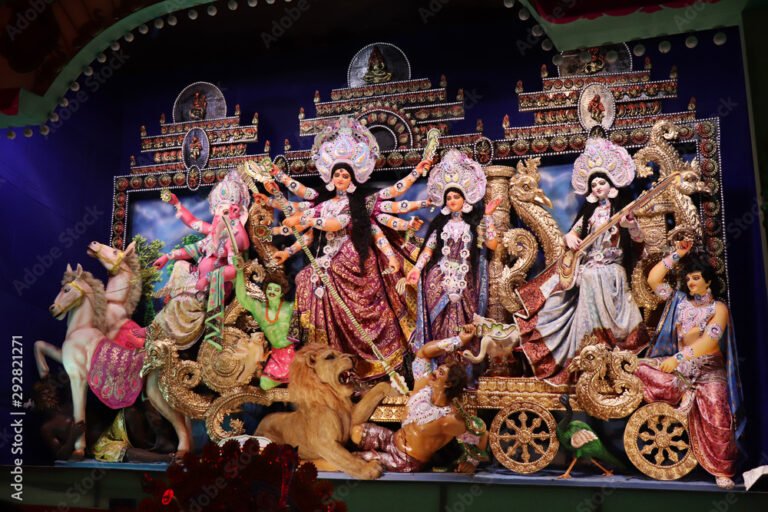
The Durga idol has evolved considerably over time. In some Vaishnava traditions, the lion is
replaced by a horse, while Shakta traditions retain the lion as the warrior goddess's vehicle.
Interestingly, the lion itself was once depicted very differently. Before Bengal's artisans had
opportunities to see real lions in circuses, private menageries and later zoos, their
interpretations were often based on descriptions and imagination. As real lions became more
familiar, their representation in Durga idols gradually changed.
The decoration evolved too. Daker Saaj, the distinctive silver-coloured ornamentation
associated with many traditional Durga idols, has an interesting history. The name is
commonly explained as dak—post or mail—because the decorative materials were imported
from Europe and arrived in Bengal by post, before being fashioned into elaborate ornaments.
Today, traditional forms coexist with increasingly creative and contemporary designs, but the
goddess remains instantly recognisable.
Flat Bari Puja – The Modern-Day Zamindars
As Kolkata evolved, a new breed of so-called zamindars emerged—the owners of flats in the
residential complexes that have spread across Kolkata and Bengal.
These are the modern-day zamindars, living in self-contained complexes, often equipped with
shopping malls, markets, restaurants and almost everything they need within their own
premises. As Kolkata and its suburbs continue to see more residential complexes, another
form of Durga Puja has grown alongside them.
Known as Flat Bari Puja, these celebrations can be no less grand than traditional Baroyari
Pujas. The old zamindar's mansion may have disappeared, but the spirit of community Puja
has found a new home—in the courtyards and common spaces of Bengal's modern residential
complexes.
Theme Pujas – When Durga Meets the World
If you are in Kolkata or anywhere in Bengal during Puja and happen to see a Durga idol in
Arabian attire peeping out of a medium-sized Burj Khalifa-like structure, or a Buddhist-style
Durga emerging from a replica of Angkor Wat, don't be surprised. Welcome to the world of
Theme Pujas, a relatively new tradition of Durga Puja in Bengal.
Earlier, particularly in the 1960s, 70s and 80s, most Durga Pujas remained centred on
traditional pandals and traditional forms of the Durga idol. The Puja itself was the main
attraction. Gradually, however, some Puja organisers in North and South Kolkata began
experimenting with pandal design and decoration, recreating famous architectural structures
from India and around the world and designing the lighting and décor around the chosen
theme.
The idea gradually spread across Bengal. Soon, themes went beyond architecture. Social
messages such as saving the girl child, literacy, environmental awareness and other social
issues became part of the Puja experience.
The pandal was no longer merely a shelter for the goddess. It became a work of art, a
storytelling medium and sometimes even a social message. In the process, Durga Puja
acquired a whole new dimension.
Traditional Pujas Across Bengal
While Kolkata's Puja has evolved into elaborate theme pandals and spectacular community
celebrations, many old family Pujas across Bengal continue to preserve traditions handed
down through generations.
The Ghosh Bari Puja of Tamluk is one such example, while the Chakdighi Baganbati Puja in
Purba Bardhaman has an especially fascinating history. The Sinha Roy family traces its roots
to Rajput commanders who came to Bengal with Mughal general Raja Man Singh. The
family's Durga Puja at Chakdighi Baganbati dates back to 1737 and continues today, with the
traditional ekchala idol and many age-old rituals still preserved.
These Pujas remind us that the history of Durga Puja in Bengal did not follow a single path.
While Kolkata kept reinventing the festival, many families across Bengal continue to
preserve its older traditions.
Conclusion
The history of Durga Puja in Bengal is not the story of a festival that remained unchanged
over the centuries. It is a story of constant evolution—from mythology to royal households,
from zamindar baris to community Pujas, from traditional idols to theme pandals and even
modern Flat Bari celebrations.
Perhaps that is the real history of Durga Puja in Bengal—not simply the history of a religious
festival, but the history of Bengal itself. As Bengal changed, so did its Puja: its patrons, its
spaces, its idols, its art and even its purpose.
Yet every autumn, in a rajbari, a flat complex or a neighbourhood pandal, the same goddess
returns—and Bengal finds a new way to welcome her.