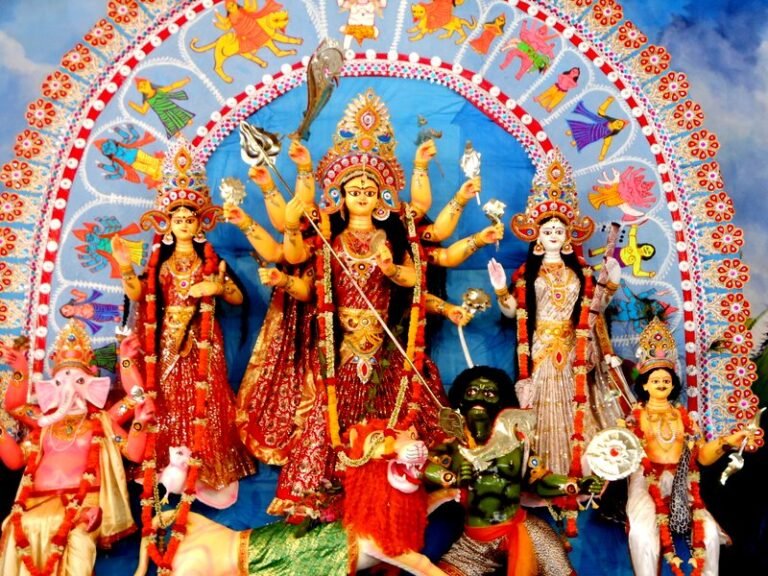
When Kolkata Welcomes Her Daughter Home

Why Durga Puja Is a Homecoming
Come September–October, Kolkata begins to change.
The city gears up to welcome her own daughter, Uma, back home from her in-
laws’ place. The city begins to fill with anticipation as it prepares for its greatest
festival of the year — Durga Puja.
According to mythology, before his war with Ravana, Lord Rama invoked
Goddess Durga to seek her blessings. Durga Puja was traditionally observed at
another time of the year. Since Rama invoked the goddess during an unusual or
untimely period, this worship came to be known as Akal Bodhon — the
invocation and worship of Goddess Durga at an unconventional time of the year.
But Durga Puja in Kolkata is more than a festival. It is a homecoming.
In Hindu tradition, a daughter leaves her parental home and settles in her in-
laws’ home after marriage. Parvati, or Uma, married to Shiva, left her father
Himalaya’s palace and began living in Kailash, Shiva’s home. Although there
are many stories about why Durga Puja is celebrated at this time of the year,
Bengali tradition sees the festival as the homecoming of a beloved daughter to
her maternal home.
According to Bengali tradition, Goddess Durga returns to her maternal home
every autumn, accompanied by her children. And Kolkata embraces her not
merely as a deity, but as a daughter returning home after a long absence.
Perhaps that is why the festival feels so personal here.
When Kolkata Comes Alive
For five days, the city seems to forget its ordinary rhythm. Streets come alive
with lights, neighbourhoods compete to create spectacular pandals, the smell of
incense mingles with the aroma of street food, and the familiar sound of the
dhaak fills the air.
To experience Kolkata during Durga Puja is to experience the city at its most
vibrant and alive. From the grandeur of the famous pujas to the intimate
celebrations tucked away in old neighbourhoods, every corner seems to reveal a
different side of Kolkata.
And the best way to discover that story is to walk through the city when Uma
comes home.
From Bonedi Bari to the Streets
Traditionally, Durga Puja in Bengal was largely the preserve of zamindar and
aristocratic families. The puja would be held within their homes, with
neighbours and local people joining the celebrations. These Bonedi Bari pujas
— the traditional celebrations of Bengal’s old aristocratic families — remain an
important part of Bengal’s Durga Puja heritage even today.
But gradually, the festival began to move beyond the walls of these grand
households.
Community celebrations emerged in Bengal, eventually giving rise to the
Sarbojanin, or community puja, that is now such a defining feature of Durga
Puja in Bengal. In Kolkata, this transformation took place mainly in the early
decades of the twentieth century, when community-organised pujas began to
flourish.
Today, the two traditions coexist. The old Bonedi Bari pujas have a charm
rooted in history, family traditions and grandeur, while the Sarbojanin pujas
have taken the festival into the streets, neighbourhoods and public spaces of
Bengal.
In many ways, Durga Puja made a remarkable journey — from the courtyards
of Bengal’s wealthy households to the streets where everyone could claim the
festival as their own.
Two Faces of Durga Puja
The Bonedi Bari pujas are traditionally held within the Thakur Dalan — the
ceremonial courtyard or pavilion of the ancestral home, where generations of
the family gather to worship the goddess. The setting itself is part of the
experience: old architecture, family traditions and rituals passed down through
generations.
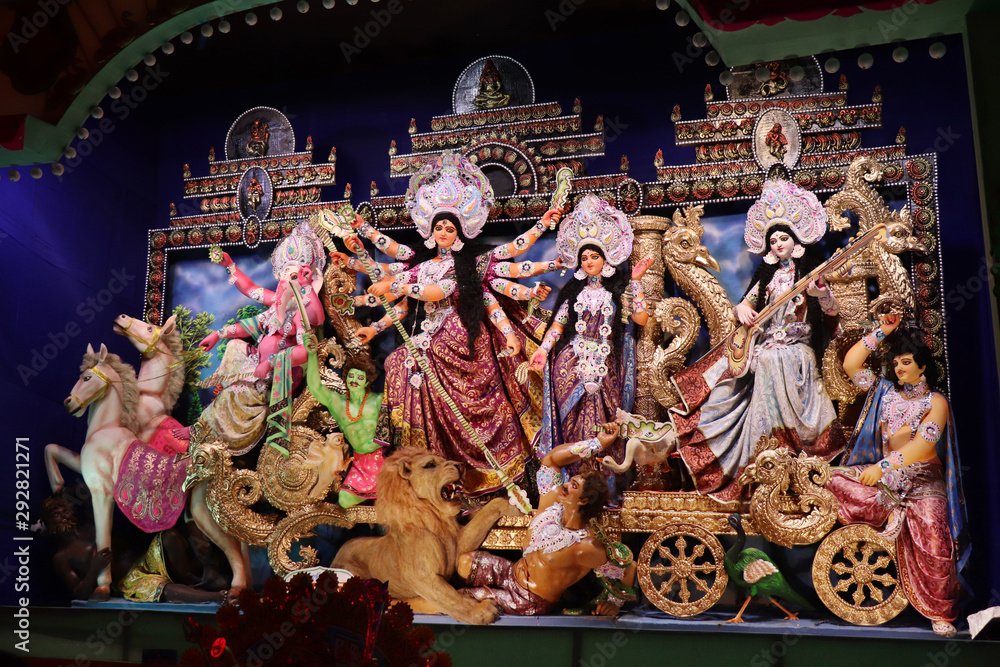
The Sarbojanin Durga Pujas, on the other hand, spill out into the public realm.
They are held in elaborately decorated temporary pandals, erected along streets,
in neighbourhoods and on open grounds. Some recreate temples or historic
monuments; others are contemporary works of art, often built around a
particular theme.
This is where the contrast becomes most striking. In the Bonedi Bari pujas, the
goddess remains within the walls of an ancestral home, surrounded by
generations of family history. In the Sarbojanin pujas, she comes out into the
streets and becomes part of the entire neighbourhood.
And this is where the real transformation of Kolkata begins — from the quiet
courtyards of its old Bonedi Bari families to the dazzling pandals that transform
its streets every autumn.
When Kolkata Begins to Transform
Although the traditional Sarbojanin pujas often begin announcing their themes
and promoting their upcoming celebrations as early as March or April, the
actual preparations begin much later. For many pujas, the ceremonial beginning
of the season is marked by rituals held around Holi or Rath Yatra.
For the Bonedi Bari pujas, the process traditionally begins with Kathamo Puja,
when the wooden framework of the Durga idol is ritually worshipped. For the
Sarbojanin pujas, Khuti Puja marks the beginning of the construction of the
pandal. A bamboo or wooden post is ceremonially installed and worshipped,
symbolising the foundation of the pandal that will eventually become the
centrepiece of the neighbourhood’s celebrations.
So, while the posters and announcements may appear months in advance, the
real transformation of Kolkata begins much later — when the first bamboo is
planted, the first framework is erected, and the city quietly begins preparing to
welcome Uma home.
From Clay to Pandal: The Making of Durga Puja
Elsewhere, in Kumartuli, the idol-making hub of Kolkata, preparations are
already underway. The artisans are busy at work, shaping the first forms of the
idols. You can experience the earthy smell of freshly wet clay, new colours and
polishing oil in the air.
As the days pass, the different studios of Kumartuli begin to fill with idols of
various sizes and styles — some resembling Ghibli-inspired figures, others
taking on the serene forms of Buddhist sculptures — each different in shape,
size and expression.
While the artisans are busy creating Durga idols, magnificent pandals begin
taking shape across the city to house them during the five days of Puja, from
Shashthi to Dashami. Somewhere, you will find an entire Jurassic Park set
gradually taking shape; elsewhere, the Angkor Wat temple emerges piece by
piece. In another corner, it is the Konark Temple being recreated. Somewhere
else, you might suddenly find the White House, complete with Secret Service
agents stationed here and there.
Altogether, the entire city begins to transform into a world completely alien to
the Kolkata that people know for the rest of the year.
When Uma Comes Home
While the city prepares for the festivities, the Bonedi Bari pujas offer a
completely different atmosphere.
Here, preparations remain deeply rooted in family tradition. The idols are often
prepared within or for the Thakur Dalan itself, the ceremonial courtyard where
generations of the family have gathered for worship. The ancestral houses are
carefully cleaned and restored, while family members living in different parts of
the city — or even outside Kolkata — begin returning to their ancestral homes
for the grand celebration.
Historic households such as Shobhabazar Rajbari, Laha Bari, and the residences
of the Sabarna Roy Choudhury family gradually come alive once again. Their
courtyards, verandahs and Thakur Dalans prepare to welcome not only Goddess
Durga, but also generations of family members returning home.
In these homes, Durga Puja is as much about family and heritage as it is about
worship. The goddess returns to her parental home — and, at the same time, the
family returns to theirs.
Mahalaya: When the Countdown Begins
The first real celebration of the Puja season begins with Mahalaya, seven days
before the actual Puja starts.
For an average Bengali, Mahalaya is not just a ritual. It is an emotion.
The day begins with the hauntingly familiar sound of Mahishasuramardini, the
iconic radio programme that has been part of Bengali life for generations. The
voice of the late Birendra Krishna Bhadra, with his distinctive delivery of the
Chandi Path, is something almost every Bengali can relate to. For many,
hearing that voice early in the morning is what truly announces that Durga Puja
has arrived.
From a ritualistic point of view, Mahalaya is the day when Hindus remember
and pay homage to their ancestors. But from the perspective of Durga Puja, it
marks another important moment. This is traditionally associated with the
painting of the third eye of Goddess Durga onto the idol, completing the final
stage of the idol-making process.
For a Bengali, therefore, Mahalaya is much more than a date on the calendar. It
is the moment when anticipation turns into reality — when the countdown to
Uma’s homecoming truly begins.
When Kolkata Becomes a Festival
Then the real Puja begins.
For five days, Kolkata and every corner of Bengal immerse themselves in a
complete festival frenzy. For these five days, the city — and much of the state
— barely sleeps.
Lights, music, the rhythmic beat of the dhaak, crowds on the streets, food stalls,
laughter and endless conversations — this is what Puja is all about. The
boundaries between day and night seem to disappear. People move from one
pandal to another, families go out together, friends meet after months, and the
entire city becomes one giant celebration.
For these five days, Kolkata is no longer just a city. It becomes a festival.
The Traditions That Make Every Bonedi Bari Unique
While most of the Sarbojanin pujas follow broadly similar rituals and
procedures, each Bonedi Bari puja has its own distinctive traditions, many of
them passed down through generations.
At Shobhabazar Rajbari, for example, the Sandhi Puja is traditionally marked
by the sound of gunshots — a ritual believed to have evolved from the cannon
fire used by the family in earlier times. Sandhi Puja marks the transition
between Ashtami and Nabami and is traditionally associated with the moment
when Goddess Durga defeated Mahishasura.
At Laha Bari, the goddess is adorned with old family jewellery, following a
tradition that has continued for generations. The ornaments themselves are part
of the family’s heritage, adding another layer of history to the celebration.
And this is what makes the Bonedi Bari pujas so fascinating. Each ancestral
household has its own rituals, customs and stories. No two pujas are quite the
same. To visit these old homes during Durga Puja is therefore not simply to
witness a religious ceremony — it is to step into a living tradition, where history
and worship continue side by side.
When Uma Leaves for Kailash
Then, like every happy occasion, the celebration comes to an end.
Uma’s holiday at her parents’ home is over, and it is time for her to return to her
husband Shiva’s home in Kailash. From the morning of Dashami itself, the air
in Kolkata seems to change. The excitement of the previous five days gives way
to a quiet sadness.
Women in Bengali households bid farewell to their beloved daughter through
traditional rituals such as Thakur Baran and Sindoor Khela. The goddess is
welcomed as a daughter, celebrated as a mother and finally sent back with the
affection reserved for a daughter leaving her parental home.
By evening, the final journey begins. From neighbourhoods across Kolkata, the
idols are carried in colourful processions towards the nearest water body, many
making their way to the Ganges. The sound of the dhaak, the chants, the
dancing and the crowds accompany Uma on her journey home.
The immersion of the Durga idol marks the end of the five-day Durga Puja
festival. The city that had been transformed for five days slowly begins to return
to its familiar rhythm.
The Bonedi Bari pujas have their own farewell rituals as well. At Shobhabazar
Rajbari, there was once a tradition of releasing a pair of Nilkantha birds before
the immersion. The birds were believed to be messengers of Lord Shiva,
carrying the news that his wife was returning to Kailash.
With the release of live birds no longer permitted, the tradition has been
preserved symbolically through representations of the Nilkantha bird.
It is a small but beautiful example of how these old pujas have adapted to
changing times while preserving the traditions handed down through
generations.
The Promise of Her Return
And perhaps that is the essence of Durga Puja in Bengal.
Every year, Uma comes home. Every year, she is welcomed with the same love
and celebration. And every year, just when the city has grown accustomed to
having her among them, she leaves again — leaving behind memories, empty
pandals and the quiet promise that she will return next autumn.