Geopolitical Realism: Trump, NATO, and the “License to Kill” Philosophy from Bob Dylan.
 Antonius Bakker
In this critique by Antonius (Ton) Bakker, the author uses Bob Dylan’s "License to Kill" and Nietzschean metaphors to examine Europe’s precarious dependence on the US. As Mark Rutte navigates NATO's survival, Bakker explores whether we are sacrificing our sovereignty out of fear. Is our security tied to a leader who views the world as his personal property?
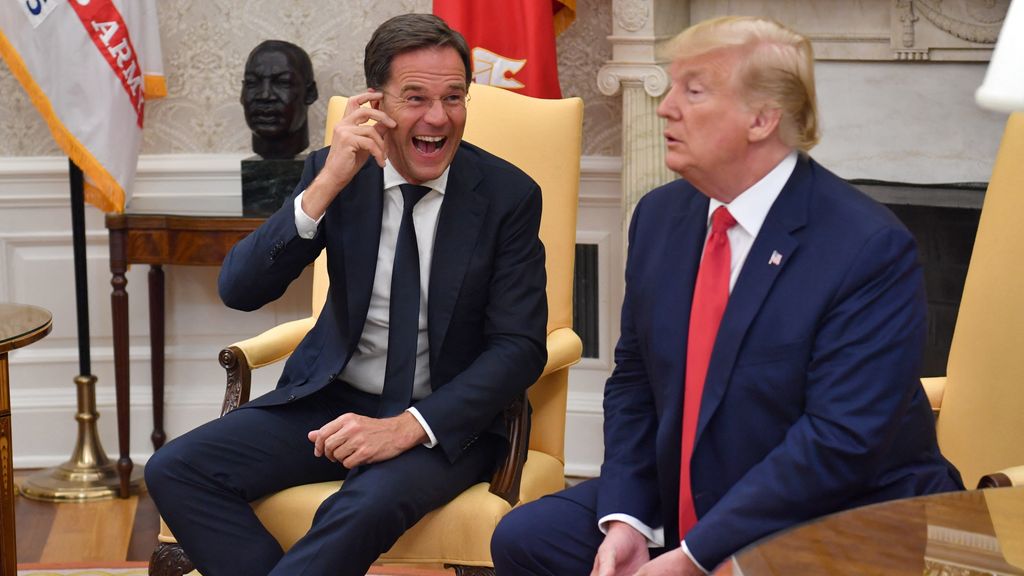
Picture: Rutte and Trump (NOS)
As early as 1983, Bob Dylan released the poignant track "License to Kill." At its core, the song serves as a lyrical warning against the hubris of man. Dylan describes an individual who walks the earth under the dangerous delusion that he is the rightful owner of the world. This figure believes that because he sits at the top of the social and political hierarchy, he has been granted a mandate to do whatever he pleases with our planet. If the natural order or the pace of change does not align with his personal ambitions, he feels entitled to "help" the earth along, often through force or environmental disregard.
Decades later, this message feels more prophetic than ever. Every time I hear this masterpiece from the eighties, I am immediately transported to the current political landscape. We see the same patterns of dominance and entitlement playing out on the global stage. We, as a global society, seem to
follow the lead of our modern "great chiefs," most notably the American president and our "so-called" great NATO ally, Donald Trump. The song asks who gave man this license to kill and destroy; today, we must ask who gave our leaders the license to gamble with the future of the international order.
The Rutte-Trump Paradox: Diplomatic Survival vs. Global Accountability
Living in the Netherlands, I am immersed in a constant stream of discourse regarding our national security and our reliance on the Atlantic alliance. Not a day goes by without domestic media outlets warning that we Europeans must be hyper-vigilant. The prevailing narrative is that we cannot afford to lose the support of NATO, and by extension, the Americans. There is a palpable fear that if the United States turns its back on the continent, our collective security will crumble overnight.
However, there is a bitter, underlying truth to this dynamic: it feels as though Europe has sold its soul to the Americans. This transaction was born out of a deep-seated anxiety regarding the rising influence of Russia and China. We have traded a degree of our own sovereignty for the promise of a nuclear umbrella. This brings me back to Dylan’s song and the "stupidities" of our modern representatives. At the forefront of this struggle is the Dutch "chief," Mark Rutte, the current Secretary General of NATO. Rutte finds himself in an impossible position—balancing the interests of a fractured Europe against the unpredictable whims of a Washington establishment that may no longer value the alliance.
Existential Threats: Russian Aggression vs. the Risks of a US-NATO Withdrawal
The current climate in the Netherlands is thick with uncertainty. Recently, a major question has dominated the headlines: Does Rutte truly understand the gravity of the words he speaks? While a significant portion of the international community is slowly turning away from Trump’s "America First" ideology, the NATO chief appears to maintain a stance of support. We must ask: is this a calculated, disguised defensive maneuver? Is he strategically supporting Trump because the alternative—an abandoned Europe—is a far more terrifying reality?
This sense of dread is trickling down to the average citizen. Why else would Dutch television broadcast daily messages advising people to hoard and store food? Such warnings are usually reserved for times of imminent conflict. This raises the question of where the true danger lies. Is the primary threat the expansionist rhetoric of Russia, or is it the internal collapse of the Western alliance? The potential withdrawal of the USA from NATO would be a geopolitical earthquake, leaving Europe to defend itself for the first time in nearly a century. We are being told to prepare for the worst, but we are rarely told exactly which "worst" we are preparing for.
The Nietzschean Abyss: Power Dynamics and the Fragility of Global Leadership
This political tightrope walk reminds me of my youth and my years spent in the corporate world. In those environments, the law of the strongest was the only law that mattered. Might made right, and those at the bottom were forced to adapt to the moods of those at the top. Does Trump realize the sheer scale of the damage his rhetoric can cause? And more importantly, does Rutte realize it too?
I am reminded of a concept often associated with Friedrich Nietzsche and the idea of the abyss. Imagine a scenario where Trump is hanging by his fingertips from the branches of a bush, dangling over a deep ravine. Now, imagine Rutte hanging over that same abyss, but he isn't holding a branch—he is holding onto Trump’s foot. In this metaphor, Rutte’s survival is tied directly to Trump’s stability. If he lets go, or if Trump falls, they both plunge into the unknown. This explains the desperate loyalty we see; the NATO boss must hold on, not necessarily out of ideological agreement, but out of the sheer instinct for survival. He must hope that Trump remains in power, for if the "anchor" fails, the entire European security apparatus goes down with it.
Will the "Big Man" Fall? Ideological Conflict and the Future of the Pedestal
Finally, we must look at the persona of Trump himself—the "big man" on the pedestal. He is a figure who presents himself as a deeply religious leader, yet his actions often mirror a desire to reignite the Crusades of old. From my perspective, it appears he views certain faiths, particularly Islam, with a dismissive or even hostile lens. His rhetoric suggests a desire to banish or marginalize an entire global religion, leading us into a series of useless, destructive wars that serve no purpose other than the consolidation of power.
If we continue to follow this path, we are not just risking a political shift; we are risking a fundamental fracture in human civilization. The "pedestal" upon which these leaders sit is built on the collective fear of the people. If we stop feeding that fear, if we start demanding a leadership that prioritizes the earth over "ownership," perhaps the license to kill will finally be revoked. Until then, we remain suspended over the ravine, waiting to see if the branch holds or if the foot slips.