Nepal Taught Me What Bangladesh Is Missing: A Sense of Civic Responsibility

A few of us journalists went to Nepal a few months ago for a training program, and I didn't expect the trip to stay with me the way it has. I went looking for material on migration and climate. I came back thinking about something much smaller and, honestly, harder to fix: the way ordinary Nepalis treat their own country and the way we treat ours.
We landed at Tribhuvan on a quiet afternoon. Immigration moved at a normal pace, mostly. Even with every invitation letter in hand, at a time when all of this could have been verified online in seconds, an officer decided our case needed a phone call upstairs first. We were through in a matter of minutes. It was a small thing, easily forgotten. But as we walked out, I found myself wondering what those ten minutes cost someone who wasn't carrying a journalist's accreditation, someone travelling abroad for the first time, perhaps to visit family, study, or earn a living for those waiting back home. For them, a few extra minutes could mean hours of uncertainty, or simply the quiet anxiety of navigating an unfamiliar system alone.
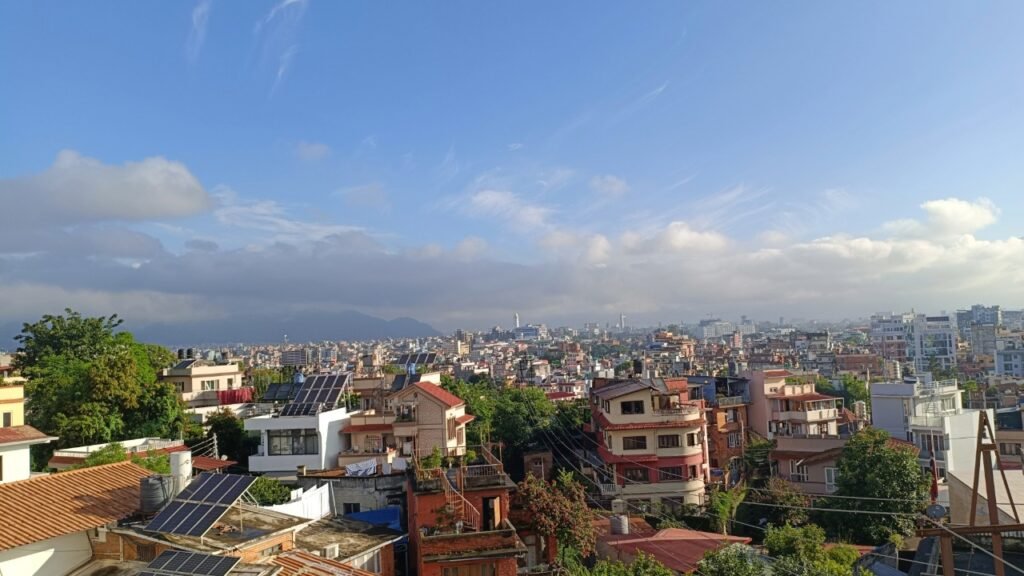
We were staying in a quiet pocket of Lalitpur, the kind of neighborhood that empties out by ten at night. No people, no noise, nothing moving. It never once felt unsafe, and that took me longer to get used to than I'd like to admit.
Here's what actually changed how I think about home. I have never in my life told a stranger on my own street "welcome to Bangladesh." It had genuinely never occurred to me as a sentence worth saying, despite being surrounded by such wonderful landscapes. But on Nepal's empty midnight roads, three of us without a working SIM card, no way to call anyone, kept stopping strangers to ask directions back to the hotel. Every single one of them did the same odd thing. They stopped, explained the route properly instead of just pointing, and before we'd finished thanking them, added some version of "You're visiting; welcome here."
It was never the same sentence twice, which is exactly what made it land. It didn't feel rehearsed. It felt like something they actually believed about their country and wanted a stranger to hear.
I think this is close to the root of whatever we're missing as a nation, and it isn't infrastructure, and it isn't even politics, not first. We haven't built a country we'd say that sentence about, so we don't.
Near our neighborhood, a small cafe run by a man who'd spent years working in Dubai stayed open past closing just to feed us, then quietly knocked money off the bill without being asked. As we left, we asked, half out of habit, whether it was safe to be out this late. He laughed at the question. People walked these streets until two or three in the morning, he said, and if anything ever did go wrong, dialling 100 would bring police fast. It was the kind of reassurance that would sound overly optimistic coming from anyone back home. Standing there, I believed him completely, and that surprised me more than the discount did. I found myself wondering whether I could say the same thing to a stranger walking through Mohammadpur at midnight and knew the honest answer was no.
The feeling followed us for the rest of the trip. A colleague in our group left his phone behind in a ride-share car, the kind of mistake that can quietly ruin the rest of a trip in an unfamiliar city. The driver turned around, drove back, and handed it to him personally. To the driver it seemed almost routine. To us it felt remarkable. I couldn't help comparing it with the one time I left a basic phone in a rickshaw in Dhaka and never saw it again. Neither story proves much by itself, but together they say something about how trust gets built, not through slogans or grand gestures, but through hundreds of small, unrecorded acts of honesty that eventually change what a visitor expects to happen next. At the food stall we found afterward, nearly half a mile on, the owner charged us the fair price without haggling and then told us, unprompted, how to get the same food delivered to our hotel for less than we'd just paid him.
None of this reads as remarkable on its own. Strung together over four days, it stopped feeling like luck.
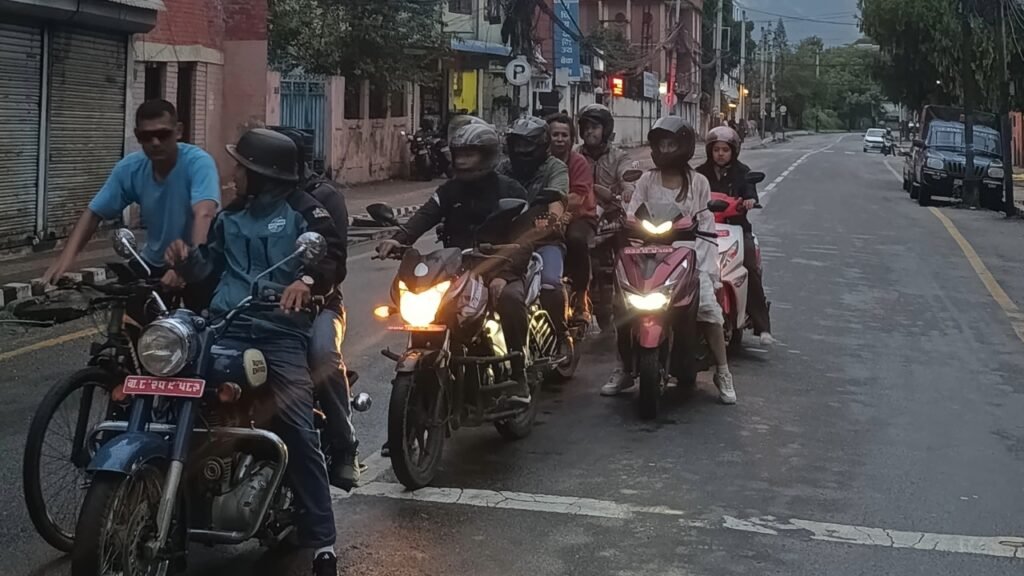
Nepal's streets are strikingly clean, and that's the first thing you notice before you notice the traffic. The second thing is that people obey traffic rules at midnight with no police in sight and the whole city asleep. Even by day, stuck in an ordinary jam, almost nobody reaches for the horn. Where I'm from, a stalled line of cars becomes a chorus within seconds. Here people just wait it out in something close to silence, and nobody is enforcing that. It's just how driving works.
A few streets over, some buildings still carried marks from the revolution that had happened not long before we arrived: cracked plaster, a boarded window, and scorch marks near a doorway. Nobody avoided looking at them, and nobody seemed weighed down by them either. The damage and the late-night laughter from a nearby bar were simply sitting on the same street, and Nepal didn't seem to feel any need to resolve that contradiction for a visitor's comfort. A country can be recovering from something serious and still hand a stranger the right directions with a smile. I'd assumed, without ever quite saying so, that those two things couldn't coexist.
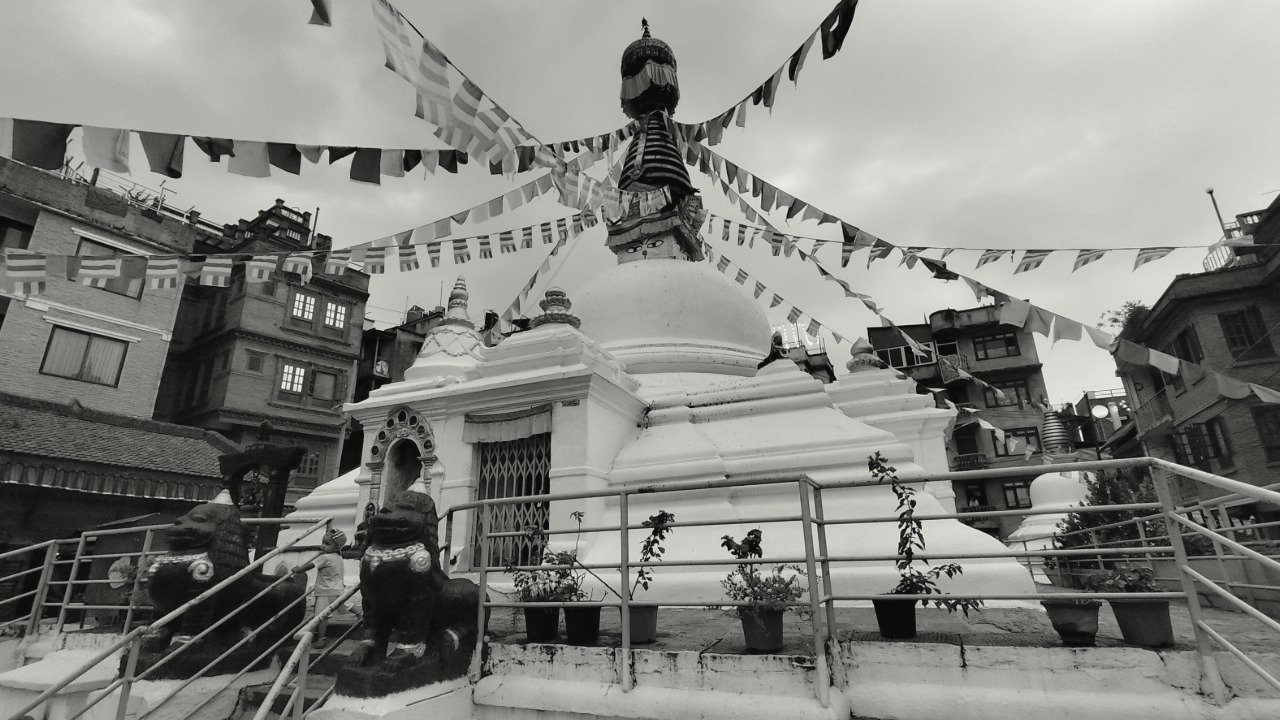
This same instinct, that a space belongs to the people standing in it, shows up somewhere I didn't expect: around Nepal's small religious sites. Viharas, shrines, and temple courtyards—almost everyone has an open patch of shared ground around it that has quietly become the neighborhood's own, assigned by nobody, built up the way trust usually is. The upkeep isn't handled by some distant authority; it falls to the families who live around it, often the same families for generations. Festivals happen there free of charge, and in return the neighborhood takes turns keeping the place clean, with no billing and no schedule handed down from above. A space you help maintain starts to feel like yours even with your name on none of the paperwork, and a thing that feels like yours is not a thing you damage. It's the same reason people sweep the pavement outside their own gate with the same unhurried care they give the temple courtyard down the road. The line between mine and ours has gotten pleasantly blurry, and I don't think that's unrelated to the quiet streets, the unhonked horns, or the strangers giving directions at midnight. It's one instinct wearing several disguises.
People here seem to follow rules because it feels right, not because someone in uniform is watching. Restaurants and bars fill up after dark, mostly with people middle-aged or older, singing karaoke, and marking small ordinary occasions. Nobody piles garbage along the roadside, not because there's a fine for it but because it apparently never occurred to them to. Women move through public space, even late, without the constant low calculation I'm used to seeing back home. On the ride from the airport, one local offered his own read on the new government, and I want to be honest that it was exactly that, one man's opinion, not a survey: most Nepalis he knew were satisfied with how things were being run, aside from a small group who'd done well under the old order. I have no way to verify that. But the confidence behind it was its own kind of evidence, the sort you can't footnote and also can't quite dismiss.
Geographically, Nepal sits an hour and a half from Dhaka by air. We could be there before a long lunch back home is finished. But measured against the kind of goodwill I watched strangers hand out for free on a midnight street, the distance stopped feeling like geography. It felt like a different country in every sense that matters, one we technically know exists and have almost never visited on our own terms.
I don't think Nepal has solved everything. I watched an officer make a call he probably didn't need to make. I walked past buildings still healing from something violent. Hardship is not absent there. It simply hasn't talked people out of being kind to a stranger, honest with a customer, unhurried in traffic, or proud enough of their own streets to walk them after midnight without flinching.
If there's a thread here for a supplement about building Bangladesh better, I don't think it starts with a policy or a budget line, though we'll need plenty of both. It starts smaller and more stubbornly with whether we feel any of this is actually ours to protect. Nepal's clean streets and patient drivers and shared courtyards aren't the result of better enforcement. They're the result of people who've quietly decided, in a thousand small unspoken ways, that the country belongs to them. Until we build that feeling into our own shared spaces, laws and budgets will keep doing the work that a sense of ownership should be doing for free.
So I keep circling back to the same questions. When will we extend that kind of ordinary decency to people we don't know? When will we stop needing the law to make us decent and start choosing it ourselves? And when, if ever, will one of us say it first, unrehearsed, the way Nepal said it to us: Welcome to Bangladesh.