The Mumbai Sabji Mandi: The Heartbeat of City Life

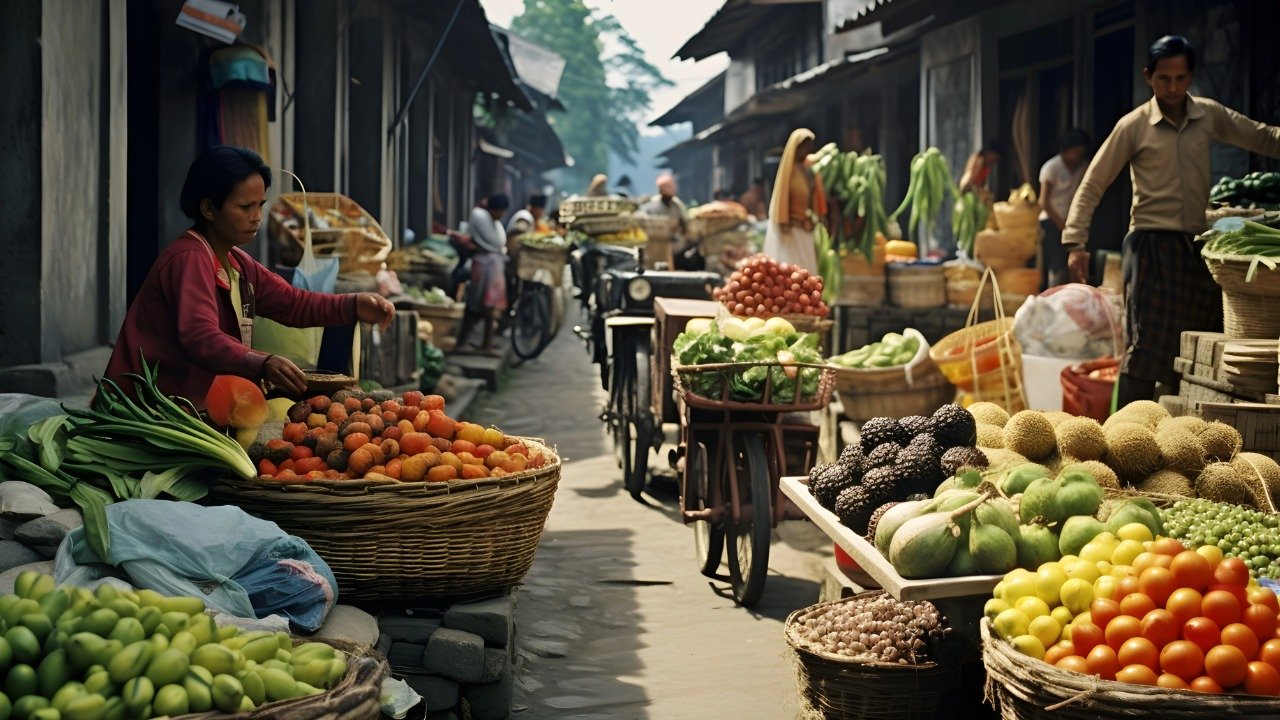
A vegetable sabji mandi is a place of busy activities and noises with fresh colorful vegetables with their shining beautiful skin arranged in different stalls and corners, soothing to our eyes. It is a market full of chaos, sweaty, and overwhelmingly loud, but it offers a masterclass in humour and human connection.
Survival—To survive in a sabji mandi, you must navigate the narrow lanes while dodging flying bundles of kothimbir (coriander), stray onions, and potatoes rolling across the floor. Fellow shoppers treat every open space like a prime real estate land grab. As there is complete chaos, rummaging through baskets of potatoes and onions, structural confusion is inevitable. It is incredibly common for someone to accidentally drop a heavy cabbage into a complete stranger’s shopping bag instead of their own. People regularly grab the hand of a random stranger, thinking it’s their spouse, only to look up and realize they’ve been walking down the aisle holding hands with a confused, 60-year-old accountant who was just trying to buy ginger.
The musical concert—The first thing that hits you when entering a Mumbai sabji market is the wall of sound. Prices are chanted in a rhythmic, competitive opera using rhyming slang, dramatic lines or funny challenges to get passers-by to stop and buy their tomatoes or onions. They create such an intense sense of fake urgency that shoppers panic and start grabbing vegetables frantically, thinking if they don't buy the cabbage right now, the entire global economy will either collapse or the vegetables will vanish forever. Vendors shout creative, poetic, and exaggerated claims such as "Aao aao, laal-laal tamatar, khao aur ban jao," and "shahrukh khan…" Aao aao! Katrina Kaif jaise gore gore aaloo le lo... Ranveer Singh jaise solid tamatar le lo... Tamatar bilkul gaal jaise laal … Arey aao, aao! Ekdum ice cream jaisa dhoodhi le lo… Ekdum Kadak Kadak bhindi le lo and so on.
The psychological war of bargaining—In Mumbai, negotiation is a fine art. The sabjiwala quotes an astronomical price for a kilo of bhindi. The buyer clutches their chest, deeply offended, as if the sabjiwala just insulted their family lineage. The buyer names a price that would essentially bankrupt the sabjiwala’s entire village. The buyer turns around and takes three slow, melodramatic steps away from the stall. The sabjiwala cracks and calls them back—"Acha thik hai, aao le lo!" (Okay fine, take it!) and they agree on a middle price that leaves both sides pretending they lost. But if the sabjiwala stays silent—no worries. The buyer awkwardly circles the entire market, comes back to the same stall thirty minutes later and they both pretend they are completely different persons.
Dhaniya-Mirchi—No matter how wealthy a Mumbaikar is, their financial integrity hinges on a single, crucial moment at the end of the shopping spree: demanding the free coriander and green chillies. After buying hundreds of rupees' worth of vegetables, the buyer will look at the sabjiwala dead in the eye and say, "Bhaiya, thoda dhaniya-mirchi toh dalo." If the sabjiwala refuses, it is viewed as a declaration of war. If the sabjiwala obliges, the buyer walks away victorious, having successfully beaten the inflation system with three free sprigs of coriander. No transaction is legally complete until the shopper demands free coriander (dhaniya) and green chillies (mirchi). Sometimes, shoppers literally grab a handful of chillies/Dhaniyas themselves and drop them into their bag while the vendor just stares upon. It is a beautiful, unspoken game of retail theft that both sides accept as a cultural tradition.
The men folks—Watch any husband or guys sent to the market by the matriarch of the house, and you will see a man fighting for his life. They stand frozen in front of a mountain of laukis, staring blankly while holding a smartphone. You will hear frantic phone calls like, "Are the tomatoes red, or are the karelas dark green or light green?" You will find them holding a single tomato to the front camera like it is a suspect in some police case, just waiting for that remote approval from home.
The tik-tik test—There is an absolute confidence with which people test vegetables they know nothing about. They will violently flick a watermelon with their middle finger, press their ear against it, nod wisely, and buy it—having absolutely no clue what a "good" watermelon knock actually sounds like. There are many who will aggressively snap the tails of the bhindis. If it snaps cleanly, it is fresh. If it doesn't make a loud, crisp snap, the vendor is reprimanded. Some possesses an ancient, genetic superpower that allows them to look at a pile of 500 tomatoes and instantly spot the single one that is slightly mushy at the bottom. By the end of the day, there is always a mountain of snapped bhindi tails and an incredibly angry sabjiwala watching his vegetables get dismantled piece by piece.
Amma and Me at the Sabji Mandi—Going with Amma to a sabji market is not a grocery run—it is a live-action military operation where she is the commander and I am the underpaid Ramu Kaka. The moment I enter the market, my dignity evaporates. My amma hands me a massive, reusable cloth bag and commands me to follow her exactly two paces behind. My sole purpose in life is now to carry increasingly heavy weights of potatoes, onions, and pumpkins without complaining. If I slow down, I get the classic glare: "Just two kilos of potatoes and you are already tired?" Amma, being a seasoned market veteran and with approximately 45 years of negotiation experience, will always approach a sabji wala like an auditor, narrowing her eyes. Like picking up a tomato, she will ask, "Why are these tomatoes like a tennis ball—so hard?" Is this from a farm or from the space? Picking up a bindi, she will say, "Look at this bhindi." It has zero enthusiasm for life…. And so on…… Standing next to Amma when she is bargaining is a masterclass in embarrassment. I go from being an independent human being to a disguised artist, praying the ground opens up and swallows me whole. All I want is to disappear while Mom destroys a sabjiwala’s soul. My phone becomes my ultimate survival tool. I pull it out and stare at the home screen with absolute, life-or-death intensity. I just swipe left and right on my apps for no reason. At times, I pretend to read an incredibly important email, nodding gravely so that the sabjiwala thinks, "Oh, that poor kid has nothing to do with this woman who is currently bargaining with me over Rs. 5." At times, my ultimate dream is to wear a cap pulled down low or a face mask so that absolutely no one—not even my friends or my neighbors—can identify me. All I do is stand there like a CID under deep cover, counting down the seconds until I can escape back to the safety of an auto-rickshaw.
The Emotional Betrayal—Indian moms are fiercely loyal to "their" specific sabji wala, treating the relationship like a sacred bond. But if they spot better quality or lower prices elsewhere, a dramatic undercover operation ensues. They will buy sabjis from a rival vendor because their regular guy wasn't around. Suddenly, if the regular guy appears down the street, they will actually hide the vegetable bag behind their back and hide their face with the saree or a duppatta. In case the regular guy spots them and says, "Aunty, today you bought from someone else?" The excuse… without missing a beat, 'Arre Selvan!' "I was looking everywhere for you! This guy forced me to buy these, but look—his tomatoes are terrible. I was just coming to you for the potatoes!"
Various types of sabji walas:
There are some who are too sarcastic. If you bargain with them, he won't get angry. Instead, he will calmly hand over an empty plastic bag and say, "Maaji, why even pay? Just take the whole stall home for free. My children will come to your house for dinner tonight."
There are some who are the vegetable matchmakers. If you pick up potatoes, he will look at you with deep concern and say, "Bahenji, you are buying potatoes, but no matar (peas)?" How will you make aloo-matar? The potato will feel lonely in the kadai." He will literally guilt-trip you into buying three more vegetables so that your dinner has a balanced script.
Then there are those "No Change" Financial Geniuses—when the bill comes to ₹97 and you hand him a ₹100 note, he will never actually give you ₹3 back. In fact, he invents his own currency exchange rate on the spot. He will confidently drop two green chillies, a tiny ginger root, or a single lemon into your bag and declare, "Hogaya ₹100!" (Now it's ₹100!)
There are the emotional sabjiwals who sell sabjis based on a sob story. He targets shoppers who look soft-hearted and uses emotional blackmail to clear his stock, like, "Bhaiya, please buy this last bunch of spinach." If I don't sell it by 8 PM, my wife won't let me enter the house. I will have to sleep on this pile of pumpkins." * The Result: You walk away carrying three kilos of slightly sad-looking spinach you never wanted, feeling like a philanthropist.
There are some who will not let you touch his vegetables randomly. If you try to pick a tomato from the bottom of his neatly stacked pyramid, he will slap a plastic tong onto your hand—"Don't touch! Eye testing only! If you touch, you buy!
Ironically, today the world has changed so much that when we shop in malls and huge shops, there is hardly any scope for bargaining. We pay the price that is quoted. Most of us neither have the time or inclination for it nor do we know the art of bargaining. Also, there are a number of online apps wherein you just tap a screen and trust a store blindly to drop your vegetables at your doorstep. No matter how much discounts these high-end malls have to offer to a typical Indian woman, they are never enough to lure an Indian mother into a mall. The local shopping arcade where they can bargain their hearts out and purchase sabji from the local sabjiwala is where they seek Nirvana.
In a world increasingly moving towards online grocery apps and plastic-wrapped supermarket aisles, these vegetable mandi’s remains a raw, unfiltered celebration of human connection. They remind us that food is an experience meant to be seen, smelled, and bartered for—a daily festival of color that keeps our kitchens alive and our cultures rooted. After all, every bustling sabji mandi is a tribute to the unseen hands [Farmers] that feed the nation.