The Sounds of Middle-Class Life: A Symphony of Everyday Rhythms
 Deepti Bhatia
It’s 5:00 AM. It’s 5:00 AM in a middle-class family: It’s 5:00 AM in an Indian middle-class family with an artistic inclination. These families are different from the non-artistic ones. They hang Ajanta wall clocks in their drawing rooms—just one. The non-artistic families hang one only if it is gifted to them at a wedding, theirs or someone else’s. Otherwise, they don’t bother. The music annoys them when it is paid for. Why would someone pay for annoyance? Free is musical; paid is nonsensical. Ajanta Wall Clock So, at 5:00 AM, the Ajanta wall clock sings its usual tune. Only…...
⭐ This is a members-only story
Get full access to all members-only stories by joining for just $5/year.
💬 Meet Our Members

Lukesh Umak
Lukesh writes about his favorite topics, such as essay, poems, health, fitness,…

Dr. B.H.S Thimmappa
B.H.S. Thimmappa is a seasoned chemistry professional with extensive experience in developing…

Tushar Sen
I work on creative and academic writing all the time. Pandora's Box…

Sindhu Gopalkrishnan
I love writing as I get to create something beautiful and touch…

Alok Singh
Alok Singh is a postgraduate student of psychology and an independent writer.…

Antonius Bakker
Antonius "Ton" Bakker, born May 23, 1961, in the Netherlands, is a…
Support independent journalism. Your membership keeps us going.
It’s 5:00 AM.
It’s 5:00 AM in a middle-class family: It’s 5:00 AM in an Indian middle-class family with an artistic inclination. These families are different from the non-artistic ones. They hang Ajanta wall clocks in their drawing rooms—just one. The non-artistic families hang one only if it is gifted to them at a wedding, theirs or someone else’s. Otherwise, they don’t bother. The music annoys them when it is paid for. Why would someone pay for annoyance? Free is musical; paid is nonsensical.
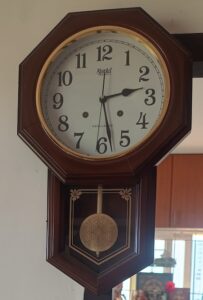
So, at 5:00 AM, the Ajanta wall clock sings its usual tune. Only background music, no lyrics—karaoke style. The whole 1300-square-foot house fills with its melody. Such homes have grown up with Ajanta; they sense time by hearing it, not seeing it. Ajanta Group understood this middle-class pulse well in the 1980s. They remain profitable to this day.
I have belonged to an artistic family for the past 18.5 years. Because we have had an Ajanta wall clock for the past 18.5 years. It hangs in the same place, singing every hour. Each hour has its distinct tune, from 1 to 12, repeating itself. We don’t mind repetition. A 12-hour gap offers enough eternity to make it fresh again. The middle class is happy with that—more than happy. Time gets melody. Their lives may not, yet their time does. Sometimes, the clock sings with a sore throat. That’s when it’s time to replace the battery. The battery, which, nine out of ten times, is either missing or cannot be found when needed. But it must be replaced. Not because time has gone awry, but because the music has lost its charm. Eventually, during an Amazon Sale Day, batteries are bought in bulk, and Ajanta gets its cough syrup. It recovers instantly.
The companionship of Ajanta with the middle-class family hinges on its hourly tunes. To the middle-class soul, it is heart-rending. Followed by intermittent sounds. Usually, the first is the sound of thunder. Not from the sky, but from the kitchen—the whistle of a pressure cooker. A 5-litre pressure cooker sits on the largest burner of a 3-burner stove, more often than not the only one that burns with adequate flame. The flame roars, the cooker whistles and thunders. They complement each other, made for each other since the historic beginning of cookers. This episode is usually brief unless the rubber gasket is in an avenging mood.
One cannot estimate the power of this thin rubber ring until one has dealt with it twice a day for three months. A bit of slackening, and you are stuck with leaking water forever. The sound of trapped steam, which should escape through the whistle, instead comes from everywhere except the whistle—threatening. At 6 o’clock, already late morning for the middle class, nothing is scarier than a cooker that won’t whistle on time. It’s a nightmare in broad daylight.
The next few hours are filled with other sounds—bedsheets being shuffled, water gushing from every tap, the clatter of vessels, the zipping and zapping of school bags. The middle class finishes its never-ending work, tasks running in parallel. Important ones squeezed between routine ones, like morning family talks, which happen in the brief pauses between the wash and dry cycles of the washing machine. Otherwise, they go unheard. Zero-noise washing machines in middle-class homes run at 100 decibels. They are vocal, like everything else—the bedroom fan that needs a complete overhaul, the tube light humming for the past two weeks, the sparking mixer wire wrapped in tape, sometimes throwing 500-volt sparks of agony. Everything competes to drown the others out. In a middle-class home, nothing is ever silent.
And then, at the end of the month, there is another sound—the sound of currency. A near-silent sound, yet powerful enough to silence everything else. The middle class loves this sound, whether in the form of crisp notes in hand or bank balances glowing on glass screens. This sound gives them a voice. It lays the foundation for future decisions—decisions about which new sounds will be added, which will be fixed, and which will be silenced. It is always the near future that worries the middle class. The far future moves too fast, too silently, becoming the near future before they know it. And yet, they hear it—just in time.
Fast forward 7 hours. It’s 7:00 PM.
There are sounds again. The sounds of people. The sounds of footsteps moving between rooms and the kitchen. The dining table fills with voices. TV sounds take over—not just ours but also our neighbors’. We listen to our TV and theirs. We discuss similarities and differences in our TV sounds. Discussions start with TV shows and lead to mindsets—inevitably. Then come the sounds of mindsets—ours and our neighbors’. Each believes their sound is better. Ignoring the similarities, which are so close they could be interchangeable. This is the song of bonding that connects middle-class families.
Within the confines of ‘upper middle class’ and ‘lower middle class,’ they move slightly up or down, never crossing the upper or lower limits. Collectively, they form the ‘mid-middle class.’ Beyond the upper limit, sounds are so silent they seem nonexistent—yet they are extremely powerful. Below the lower limit, sounds are so loud and public that middle-class sophistication finds them embarrassing. So, the mid-middle-class sounds stay within their confines, ever-changing and yet never changing.
Time moves at triple speed—three hours in one hour. It’s 10:00 PM. The Ajanta wall clock sings again. Each song piles onto the already triggered anxiety. The day is ending. The sound of time mixed with the sound of anxiety speeds things up like a catalyst. Ten hours’ worth of work gets squeezed into four. The resulting screech is terrifying to an outsider, like an overloaded machine about to collapse. To the middle class, it is an everyday ritual. They are unbothered.
These sounds, in different notes and tones, say different things. All mixed up, yet distinct. The sound of frustration and the sound of calming down. The sound of missing books and stationery and the sound of desks being ransacked. The sound of hopelessness and the sound of hope. These sounds prevail for a few hours. Then, they submerge into silence.
The middle class sleeps.
To relive the same sounds the next morning. With Ajanta wall clock, at 5:00 AM.