Chanakya’s Arthashastra and Hidden Voices: Who Truly Writes Our Political History?

The Origins of an Ancient, Ruthless Wisdom
"The enemy of my enemy is my friend." This famous maxim is attributed to Chanakya, an Indian writer and philosopher who lived from approximately 350 to 283 BC[cite: 3]. According to insiders, he served as the prime minister to the first Maurya emperor, Chandragupta, working closely alongside him[cite: 3]. Chanakya was also the mastermind who laid the preparatory groundwork for the Mauryan coup d'état[cite: 3]. Originally a philosopher and political teacher at the ancient school of Takshashila—one of the earliest centers of higher learning in the world—Chanakya is widely regarded as a pivotal figure in the establishment of the Maurya Empire[cite: 3]. This vast empire arose from the ashes of fragmented kingdoms and the looming threat of Greek invasions following the campaigns of Alexander the Great[cite: 3]. During those turbulent times, he served both Chandragupta and his son Bindusara, both of whom ruled over the first empire to encompass nearly the entire Indian subcontinent[cite: 3]. This geopolitical feat would have been unthinkable without Chanakya's relentless strategies.
Kautilya, Vishnugupta, and the Mystery of Identity
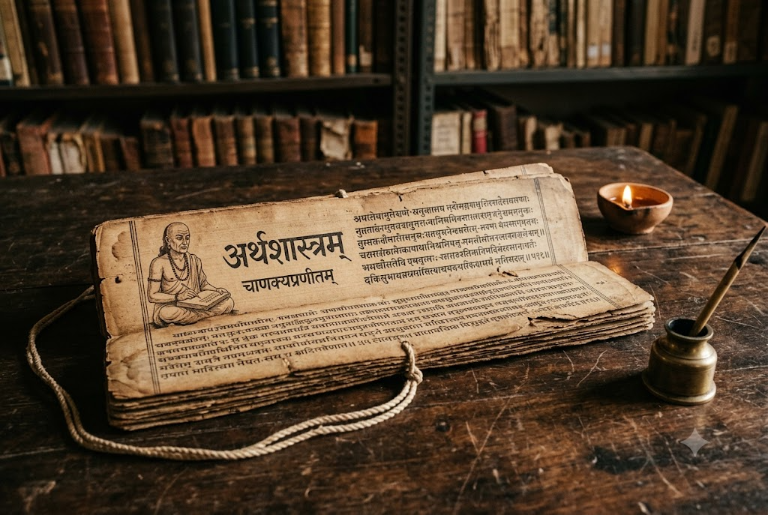
Kautilya and Vishnugupta are historically recorded as the authors of the Arthashastra, an ancient Indian treatise on statecraft[cite: 3]. Today, it is generally accepted that both names belong to the same individual as Kautilya, who in all probability is synonymous with Chanakya[cite: 3]. Some scholars consider Chanakya to be the world's very first economist, or label him "the Indian Machiavelli," though later historians heavily dispute this comparison[cite: 3]. According to them, Kautilya may have lived several centuries later[cite: 3]. This historical confusion exposes a fundamental problem within historiography: how reliable are our sources when the identity of one of antiquity's most influential thinkers remains shrouded in mists of speculation and myth-making? It forces us to cast a critical eye upon the foundations on which we build our historical knowledge.
The Custodian of Absolute Power
Kautilya, as we shall call him for the sake of convenience in this piece, is thus believed by many to have penned the Arthashastra[cite: 3]. Yet, it is increasingly clear that almost no one in our modern era knows exactly when these treatises were composed[cite: 3]. While Kautilya might have been the original author, the only surviving version of this work is a redacted edition by Vishnugupta, a man who lived around the third century AD[cite: 3]. The Arthashastra is essentially an instruction manual written for an authoritarian ruler who is unconditionally prepared to go to the absolute extreme to maintain his grip on power[cite: 3]. It serves as a blueprint for Realpolitik avant la lettre, where moral considerations yield entirely to the interests of the state. The preservation and expansion of the ruler's power are the highest goals, legitimizing any means—no matter how cruel or deceptive.
A Centralized Network of Espionage and Terror
The ancient text describes a highly centralized form of government through which the ruling monarch can maintain control over his own populace as well as neighboring states, upon whom he tightly turned the thumbscrews[cite: 3]. The manuscript details exact methods of tax collection and how the ruler appropriated these resources to finance a massive war apparatus[cite: 3]. It also outlines how the king deployed spies—disguised as ascetics, merchants, and even courtesans—to stay precisely informed about the undercurrents among his people[cite: 3]. This espionage network served not only to crush rebellions in the bud but also to spread disinformation and destabilize adversaries. Simultaneously, Chandragupta used this intricate web to keep a watchful eye on his closest advisors and ministers, intervening with terrifying, ruthless force whenever he deemed it necessary[cite: 3]. Paranoia was elevated to an administrative art form.
Cunning Diplomacy and Strategic Subjugation
Chandragupta maintained highly cunning methods for his time. He subjugated neighboring states to his rule as soon as they showed signs of weakness, while playing stronger neighbors against one another with sophisticated diplomacy until they, too, were ripe for submission[cite: 3]. This concept is known within the Arthashastra as the 'Mandala Theory,' which posits that a direct neighbor is a natural enemy, while the neighbor's neighbor is an automatic ally[cite: 3]. Some historians view the Arthashastra as an influential source on how power dynamics and the administrative structure of a state were shaped during that era[cite: 3]. Yet, many still debate whether the text was intended to be normative or merely descriptive[cite: 3]. Was it a reflection of reality, or an utopian handbook for total control?
The Shaky Foundations of Our History Books
In all honesty, I often wonder what exactly we are supposed to do with these kinds of texts. As you have read, I have thrown around many names and personas in this piece who, according to tradition, might be the exact same person, or entirely different characters living centuries apart[cite: 3]. For me, it remains deeply disorienting to accept that much of what we are forced to read in school history books and commit to memory is built upon these types of assumptions and conjectures[cite: 3]. We consume the past as a fixed fact, when in reality, it is often a fragile house of cards made of interpretations, translations, and politically motivated revisions.
Invisible Voices and the Pen of the Victor
Library shelves are filled with volumes detailing how things supposedly came to pass[cite: 3]. Much of the data used for this comes from even older books and texts salvaged from ancient libraries, or unearthed during archaeological digs[cite: 3]. But how much of it is genuinely true? It has become clear to large segments of the global population that history is far more often written by the victors than by the vanquished[cite: 3]. Is it not true that an overwhelming number of historical texts flowed solely from the pens of arrogant, powerful, and wealthy men[cite: 3]? The voices of the oppressed, the marginalized, and the defeated have been systematically erased or distorted, leaving us with a fundamentally one-sided view of human civilization.
The Erased Role of Women Throughout the Ages
It has also been known for centuries that women played crucial roles that were rarely recorded in truly ancient texts[cite: 3]. The Arthashastra mentions women occasionally as spies or weavers, but largely reduces their societal status to property and reproductive instruments. The reality becomes even more bitter when one considers that until recently, women were historically treated as objects to be gambled away by men, and many who dared to speak their minds perished at the stake[cite: 3]. This institutional oppression is not a distant, historical anomaly. It was only in 1980 that the law was abolished in the Netherlands which dictated that a married woman was legally bound to follow her husband in everything he said or desired[cite: 3]. This means I cannot even compare our modern era to the times in which my parents grew up, let alone to distant antiquity. Historically speaking, emancipation has only just begun.
What is Wisdom in an Unemancipated Past?
Can you tell me what wisdom truly is[cite: 3]? Should we first investigate everything thoroughly before passing it on to others, or should we blindly "march forward in the progress of nations"[cite: 3]? Why do we continue to learn what unemancipated men wished to dictate to us from their proud books of conquest, and why do we not listen much more to the hardworking, child-bearing, and worldly-wise women of antiquity[cite: 3]? Why do we persist in studying the structures of authoritarian thinkers like Chanakya as the bedrock of political philosophy, while half of humanity has been deliberately kept outside the pages of this history? Do we truly possess wisdom if we refuse to listen to the very voices that were silenced so long ago[cite: 3]?
Do you know?