The marginalisation of art


Walter Benjamin has written, 'Only that historian will have the gift of fanning the spark of hope in the past who is firmly convinced that even the dead will not be safe from the enemy if he wins.' This quote is validated by the documentary ‘The Other Song' by Saba Dewan, which has skilfully shown how dominant history telling has completely sidelined the art of ‘thumri’ singing, where one word could stir up different meanings and emotions.
The documentary focuses on Rasoolan Bai, a famous thumri singer from Banaras who has sung ‘phool gendwa na maro, lage karijva main chot’. It moves ahead with interviews of the last thumri singers and other scholars of music about how this song had another version, 'Phool gendwa na maro, lage jobanva main chot’, which wasn’t ever sung again by Rasoolan Bai. There is also an archival interview of her where she talks about her family. The movie is a journey to the past lives of these singers when they were in the forefront of the culture of art and music.
Gradually it opens up issues surrounding morality and purity. In the start of the film, a house is shown where tawaifs used to sing in the main hall of the house. The man in the documentary, Rastogi Ji, talks about his grandfather who was a great fan of thumri singing. He shows the hall where the event was organised with a collection of music records of these singers. Interestingly, he points out the upper floor where the women of the house watched the tawaif’s singing from behind the shutters so that they could escape the gaze from below. This shows a clear demarcation between ‘respectable’ married women of the house who were kept in veils and other women who performed in front of the same men who kept their women in the private realm. At present that hall has been transitioned into a temple.
For a long time, tawaifs were identified as professional musicians in India. They were educated women adept in literature, music and art, and with the ideas floating around, they sang in mehfils and courts during that phase. The interviews with various thumri singers bring out the stories which revolve around their love for music and how much they trained themselves to be good at it. One of the singers says that singing wasn’t allowed for women in her house, but she secretly practised it until her father saw her talent and trained her like her other brothers.
Another thumri singer who was famous at a young age talked about how her style of singing was misinterpreted. She was at times called a prostitute and was despised. She even talked about her falling in love with a married man whose death made her empty from within. Later another man came in her life who always thought that every song she sang was dedicated to him only. But in the movie, she clarifies that thumri singing is so deep and intense that people think that the singer is just singing for them.
Another thumri singer who has done theatre also talks about her love for singing. She says that after marriage she didn’t sing, which led her to lose her health. After constant checkups, one Bengali doctor realised her issue and asked her to start singing again. She even says that marriage and childbearing for an artist is a disaster. She says, 'To keep in touch with your art, one must not go the conventional way in life.'
Zarina Begum, who was once a thumri singer in Lucknow, now lives with her old husband in a dilapidated house. She gets nostalgic about a nawab who came to listen to her but had no understanding of what she was singing. So she sang a song for him, which is a famous one, 'Nazar laagi raja tohre bangle par’. She was adopted and trained by Begum Akthar, who is another great thumri singer of Lucknow.
There was another famous singer shown in the movie who has now become a social worker and trains girls in music. She also talked about a prince hailing from Bilaspur. She exclaimed that he put a gun on her head and asked her to come with him. She expressed that people came with a lot of expectations and desires to her, but not all desires could be fulfilled.
Thumri singing was an art of tawaifs who openly and explicitly displayed their raw emotions of love and heartbreak and sexuality through the songs. But gradually, with the decline in princely powers and the power passing on to the state, the future of thumri became bleak. Then the reformist movement in India commenced, which focussed on morality and traditions. Thumri was seen to be erotic and too sexual, such that the singers lost their importance by then.
They got sidelined by the ideas of patriarchal and puritanical forms of music. The rise in texts of history that blamed Muslims and tawaifs for ruining the ‘Hindustani’ culture also furthered the marginalisation of these women and the art. The singers resorted to theatres and films. All India Radio asserted to only allow those thumri singers who have a marriage certificate and those who don't have a scandalous life. Rasoolan Bai and Begum Akhtar were working in All India Radio as they were married. Marriage as an institution has been a tool for the acceptance of women in society. The respectable title the singers got was 'devi', while Rasoolan Bai was being called ‘bai’.
The difference between ‘jobanwa’ and ‘karejwa’ was crucial. The former wasn’t used by Rasoolan Bai again in her song, and it was thrown into oblivion in order to clean the history of this immoral blotting of desire and eroticism. Hence making Hindustani music a cultured realm where the new Indian middle-class population could fit in. The women were to remain in the private realm and under the traditional roles of wives and mothers. Tawaifs were deviant and daring. They had a direct approach with the elite and had the power to choose their partners.
Singer like Begum Akhtar contributed to the Indian national movement by providing her space to the leaders to carry out secretive meetings in order to them keep away from the British eye. She even took responsibility for the whole ‘mohalla’ by providing money for marriage and education in the families living there. National leaders like Gandhi chided the tawaifs to support the national movement by giving money to the poor, supporting the sick and also contributing in the Satyagraha. He demanded they leave their profession and hence kept them off the resistance.
The question always arises to my mind as to why Begum Hazrat Mahal or the Rani of Jhansi is the face of the Indian national movement for independence while Begum Akhtar isn't. This is directly linked to the moralistic lens of the society. The national subconscious is gagged by the ideas of tradition and culture such that music and art also get engulfed in the ambit of religion, which is clearly shown in the latter part of the documentary. The tawaifs had to give up their music and abandon their instruments.
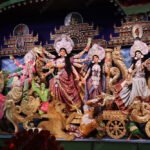
The documentary further shows men aimlessly dance around the Goddess Durga’s idol on the road, celebrating the sanctity and purity of females. There is a change in the whole scenario of music post-independence. The map of India changes from a ‘gainda’ flower to the image of ‘Bharat Mata', which signals to a change in the culture where women are seen as the honour of a community, caste, religion and country as a whole.
The marginalisation of thumri is part of the bigger movement where many other art forms and ideas got subdued by the majoritarian idea of ‘Hindi, Hindu and Hindustan’. The glorification of Sita, Sati, and other women who sacrificed their lives for the sake of values and virtues embedded in the Hindu culture was now an epitome of greatness. The women who deviated from this path were wrong and impure. The upper-caste educated women took the main frame as they represented the respectable married women's image.
There is a need to retrieve these dying strands of history in order to have a record of them and preserve the undying appreciation for them by many. The art and movements pioneered by women and other marginalised groups have to be given utmost importance, as their subjugation is rampant. Caste, gender and class intersectionality have adverse effects on history writing. History has been dominated by the rich and authoritative. Another question arises out of the documentary and readings: why do women have to face the brunt of morality and culture while the men/audience who keep wives as well as lovers are decorated in history?
It is important to use oral history as a way to go into the lanes of lost stories because it helps provide perspectives of people who might not otherwise be traced or heard. The other song gives a great insight into the field of thumri singing, which has almost died, leaving behind its singers with nothing but memories.